How I Accidentally Became Obsessed with Parking
I’ve always been fascinated with why things are the way they are. Why is a giraffe’s neck so long? Why are the Rockies taller than the Appalachian Mountains? Why do planes only have two engines now when they used to have four? I had a lot of questions. One of my favorite channels growing up was The History Channel, before it became dominated by reality television. I was in it for the history, damnit! It helped me understand why the world around me was the way it is today. As an adult who has traveled much more and seen how other people live, I started asking questions about my own hometown when my wife and I decided to move back to Louisiana. I started wondering why does Thibodaux, Louisiana – a charming city with a picturesque downtown along Bayou Lafourche – have so many parking lots, many of which are empty the majority of the time? It’s not like Thibodaux is unique in this regard, though. Parking lots are everywhere. I remembered riding my bike as a kid through large parking lots, while making the treacherous journeys that children in Thibodaux endure to do seemingly normal things like ride their bike to a friend’s house, but I never really questioned why they existed in the first place. It became something I thought about often: how these parking lots were negatively impacting this place. I had to find out why and I wasn’t sure where it would lead me. Three months later, my initial curiosity turned into something much larger. I’m now drafting a proposed amendment to Thibodaux’s zoning ordinance that would eliminate minimum off-street parking requirements citywide. What follows is my attempt to answer the question that first occurred to me while looking across those empty parking lots: why were they built in the first place? Along the way, that question led me into the history of zoning, the relevant history in Thibodaux, transportation policy, and urban planning – and ultimately to propose changing Thibodaux’s zoning ordinance.
If I wanted to understand why Thibodaux – and most American towns and cities – have so much off-street parking, I had to learn some history. Like any good History Channel episode, the story starts from the beginning, and the first question I needed to answer was: How did automobiles come to dominate city streets that once belonged to everyone?
I learned at the dawn of the twentieth century the question wasn’t where cars should park – it was who the streets belonged to in the first place. The outcome would determine who public streets were ultimately designed to serve, pedestrians and other users or – the new kids on the block – the automobile. When I look at the streets of Thibodaux today, the answer seems obvious. Cars won. But before the 1920s the automobile was seen as the intruder, depriving everyone else of their freedom to the street. Not the other way around.
People seeing a car as an intruder was foreign to me. It was hard to imagine, but I learned early twentieth-century courts generally treated public streets as shared public spaces where pedestrians had long-established rights. That attitude is reflected in a 1919 opinion by New York police magistrate Bruce Cobb, who argued “if pedestrians were at their peril confined to street corners or certain designated crossings, it might tend to give selfish drivers too great a sense of proprietorship in the highway.”
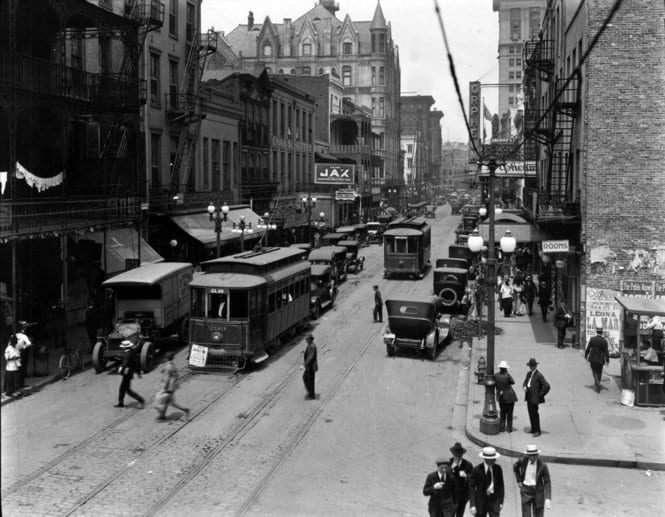 New Orleans street cars from
Know Your NOLA: The Rise, Fall, and Rebirth of Streetcars (Part 1)
New Orleans street cars from
Know Your NOLA: The Rise, Fall, and Rebirth of Streetcars (Part 1)
Over time, automobile interests successfully shifted public opinion. They popularized terms like “jaywalker,” portraying pedestrians – not motorists – as the ones misusing the street. The kids in the street were now the ones in the way of the automobile. The cost of owning an automobile also dropped drastically. Cities now faced a new problem: where to store these automobiles.
Public streets were becoming overcrowded, and curb parking was free, first come first service, and had no time limits. Naturally, employees usually occupied prime spots, leaving none for paying customers. If that sounds familiar, it’s basically how curb parking in downtown Thibodaux still works today (there are also proven ways for the city to better manage this limited resource and they don’t include building more parking). The history of parking regulation is surprisingly rich. Eran Ben-Joseph’s From Chaos to Order: A Brief Cultural History of the Parking Lot provided me with an excellent overview. The biggest surprise wasn’t that cities wanted more parking. It was who they expected to pay for it.
Instead of building and paying for enough parking themselves, cities increasingly required private property owners to provide parking on their own land. The result was a new development pattern that feels completely ordinary today where nearly every home, business, church, school, and restaurant is surrounded by its own dedicated parking lot.
One of my questions was now answered, but it raised another. How exactly does the law in places like Thibodaux mandate all these large parking lots? The answer lies in off-street parking minimums.
Imagine a small business owner wanted to lease an old historic building that used to be a hardware store to open a coffee shop. You can imagine this person being me. I’ve been telling my wife I think Thibodaux could use another local coffee shop, where it’s not weird to order just a double espresso, with no milk or sugar. Just espresso. I’ve even imagined where I’d put it: an old historic building near one of Thibodaux’s traditional neighborhoods, with sidewalks connecting nearby homes and on-street parking already available. Let’s call it Mocca Joe’s. Unfortunately, changing the building from a hardware store to a coffee shop triggers different parking minimums for “coffee shops.”
The number of spaces is determined by the square footage of the building and nothing else is taken into account – not the surrounding neighborhood, existing on-street parking, nearby businesses, sidewalks, whether many customers are likely to arrive on foot, or any other factor that would determine the real parking demand for the coffee shop. If the land use change requires more parking and space isn’t already available on the property, I’d be forced to buy an adjacent lot to build more asphalt parking. Building more parking also means building the proper drainage to mitigate storm water runoff and the increased flash flood risk to the surrounding area, increasing costs further for my proposed coffee shop (it also increases the cost of storm water management for the city).
If a neighboring store had parking capacity and the other owner and I wanted to enter into a legal agreement to share parking, there would be further government mandated barriers. For example, Thibodaux requires the two businesses to be within 300 feet of one another, not taking into account pedestrian routes, and prove to the zoning board that their peak parking demand doesn’t overlap. At that point, opening a neighborhood coffee shop starts looking a lot less appealing to me. Not because people don’t want coffee, but because the city has quietly made it much more expensive to serve it.
Starbucks on the other hand can just come into Thibodaux, buy lots near Nicholls State University, build a big parking lot, and serve their coffee. The parking is free but it’s priced into everything else, even if I survive the bike ride there on the unprotected bike lane (the shoulder).
I read portions of Kissane v. Town Council of McCandless, a case between 16 residents of McCandless, PA and the Town Council. It illustrates one reason developers may choose to build parking according to zoning requirements, sometimes exceeding them, rather than challenge them. Walmart believed the city was requiring more parking than was needed, and decided to hire consultants to actually study the real parking demand for similar stores. They found the 6.67 parking spaces per 1,000 square feet was too much. Getting approval meant additional hearings, testimonies, and ultimately litigation. Walmart ended up winning the case, but at was cost? It shows challenging these laws are not always in the best interest of these corporations, maintaining the status quo.
Until recently almost every city in America had these minimum off-street parking requirements for an assortment of land uses in zoning ordinances. Thibodaux’s zoning ordinances require each developer and private property owner to build and maintain an expensive parking lot. For example, a funeral Home’s minimum is 1 space/4 chapel seats + 1 space/300 sf of office. I kept finding stranger things buried in the ordinance. As I kept reading, I found other regulations that made it remarkably difficult for long-established neighborhood businesses to survive. The story of Tom’s Bike Shop & Lawn Mowers’ struggle to repair the store after Hurricane Gustav illustrates how Thibodaux’s zoning code was – and still is – actively destroying cherished historic neighborhoods with diverse, walkable landscapes and local business.
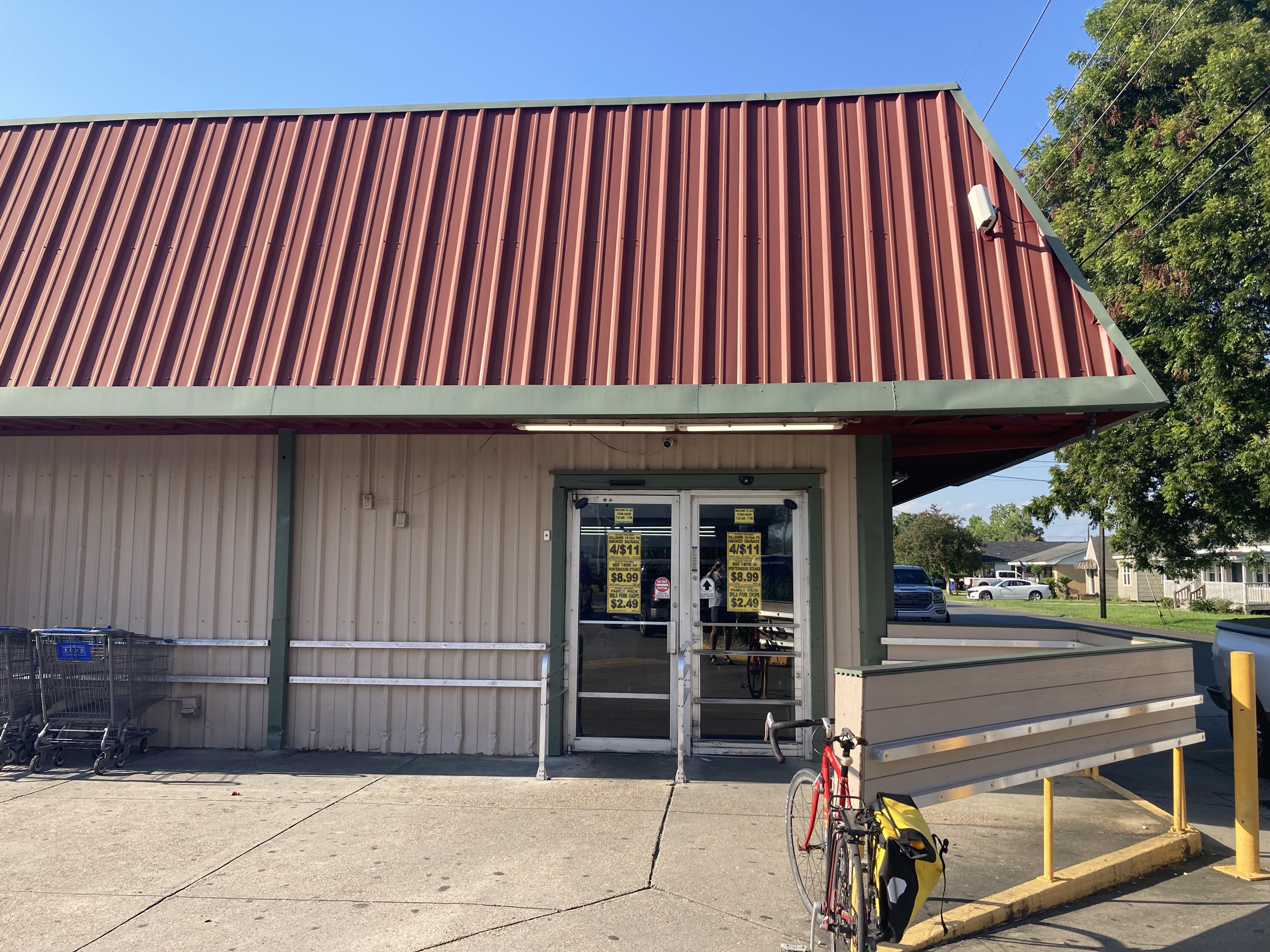 I recently rode my bike to the best neighborhood grocery store in town, L&N.
Tom’s Bike Shop & Lawn Mowers has been around forever. Tom’s is located on N 7th Street in a historically walkable Thibodaux neighborhood. Going west from Tom’s is the iconic (at least to me) L&N grocery store, and a bit further is The Place, one of Thibodaux’s few neighborhood bars that seems to have good food, too. Right next to Tom’s shop going east on N 7th Street is the old Ice House (we’ll come back to this historic building later).
This area in Thibodaux is rich with historic buildings and local businesses, integrated right within the fabric of the neighborhood. I’d argue the businesses help create a strong sense of community. They do more good than harm. I remember helping my friend bring his family’s lawn mower to Tom’s to get fixed. We walked from their house down to Tom’s to see if the repairs were done.
After Hurricane Gustav wiped out a sizable portion of Tom’s store he wanted to build it back bigger and better. The problem was the law wouldn’t allow it. He could only re-build it the exact same way, and even that was capped. You see, since Tom’s store existed before strict zoning districts, Tom’s business was grandfathered into the new R-2 (Single Family Residential) zone. Under traditional zoning codes, Tom’s store is considered a “non-conforming” business and can only maintain that status if it stays exactly the same way. Otherwise, it must abide by the strict zoning rules, triggering things like minimum parking ratios. In this case it was in a R-2 district, so it couldn’t even exist if it lost this status. Before the city allowed these non-conforming businesses to make repairs equal to 100% of the replacement cost of the building (they can’t make improvements to this day), non-conforming businesses were not allowed to make “renovations or ordinary repairs costing more than 10% of the building’s replacement cost.” The Planning and Zoning Commission at the time initially recommended raising it to only 75%, but former Councilman Chip Badeau shot that down since “using specific figures was arbitrary.” Sound familiar?
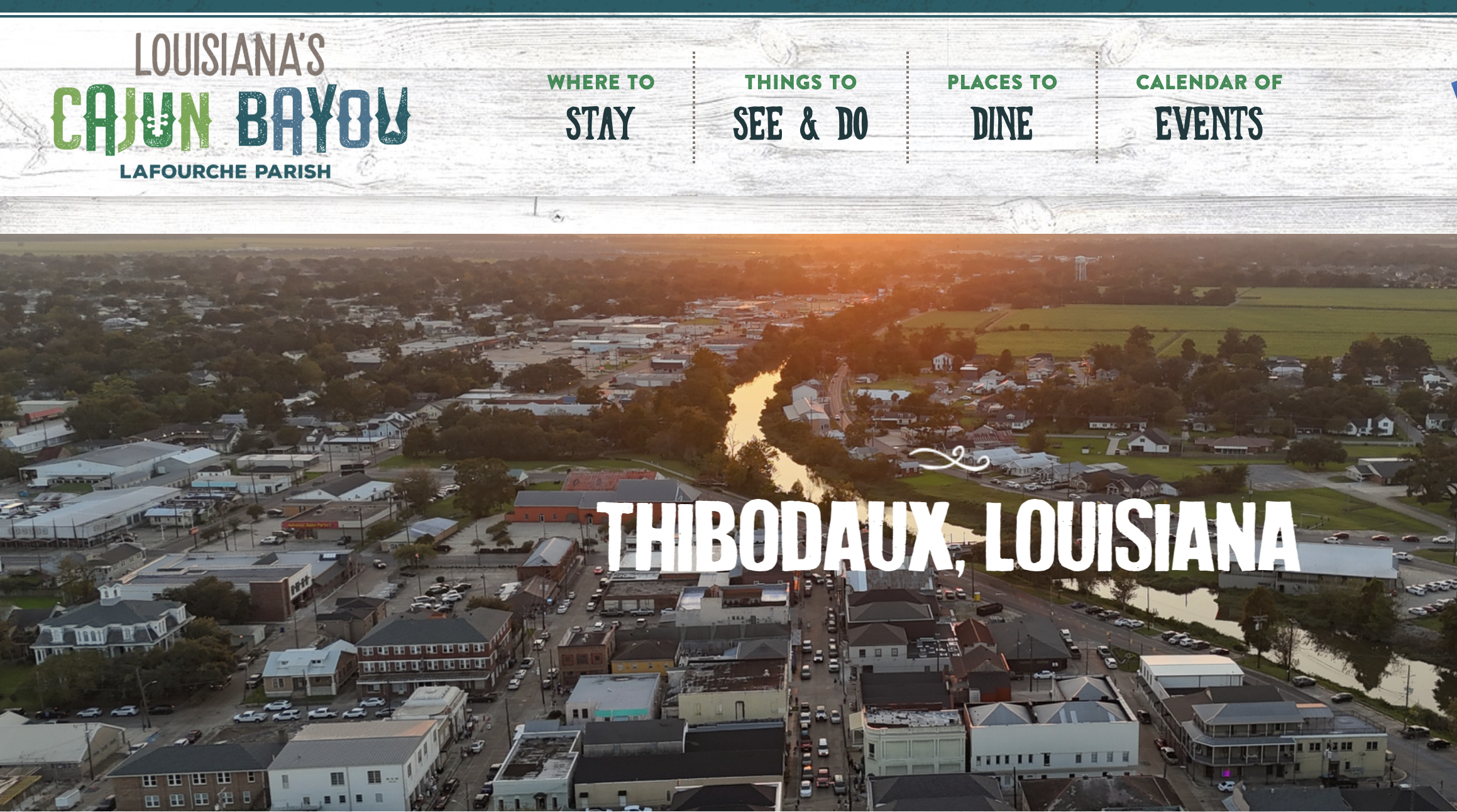
If you haven’t noticed, many of Thibodaux’s local businesses are located within the Central Business District (CBD). This district is actually exempt from a lot of these ordinances, including minimum parking ratios. A 2014 zoning overhaul, which was partly the result of local residents’ frustration with a Planning and Zoning Commission’s proposed change to tighten parking ratios even more, established this new district and made the exemption. If parking minimums were supposedly so important, why had the city exempted Downtown? It’s simple: Thibodaux residents and city officials finally realized the historic area couldn’t exist with these laws. Downtown Thibodaux’s dense walkability is effectively illegal to develop today and would not have survived under today’s rules. That would be bad. Thibodaux uses the picturesque downtown area in promotional materials. They don’t usually use the urban sprawl and large parking lots that dominate North Canal Blvd.
At this point I wondered if I was convincing myself these minimum parking ratios were bad. Maybe they existed for good reason? I put it off for a while but I knew what I had to make myself do next: read academic literature. Not surprisingly what I found was numerous academic, economic, and urban planning studies that confirmed what I suspected. Numerous studies have shown that these mandates are typically based on limited or outdated data rather than actual demand, causing cities to require substantially more parking than many businesses and developments need. They result in higher construction costs, higher housing and commercial rents, more impervious surfaces that contribute to flooding, reduced walkability, and increased car dependency. Rather than preventing parking shortages, many of the researchers argued that cities should allow the market to determine parking supply while managing on-street parking through pricing or time limits where necessary. The free market for parking is a more efficient one than the one where the government mandates a surplus. It does more harm than good. I also learned about a new trend. Many cities, big and small, across the country were beginning to remove minimum parking ratios from zoning ordinances. North Carolina recently based a bill prohibiting local governments from enforcing mandatory minimum parking space counts based on occupancy, letting developers decide parking supply. The short bill can be accessed here.
Here’s what all of this looks like when you apply the city’s parking ordinance to an actual building: the Ice House. The building was formally the Olde Icehouse, an iconic Thibodaux bar where local residents could crack a cold one with friends after a hard days work. It closed in 2017 and is currently vacant listed for sale.
LACDB’s listing for the Ice House says “the property offers ample on-site parking, with areas along the front, side, and rear of the building. A newly drafted proposed parking plan also outlines opportunities to expand parking capacity if desired, providing flexibility for future commercial growth.”
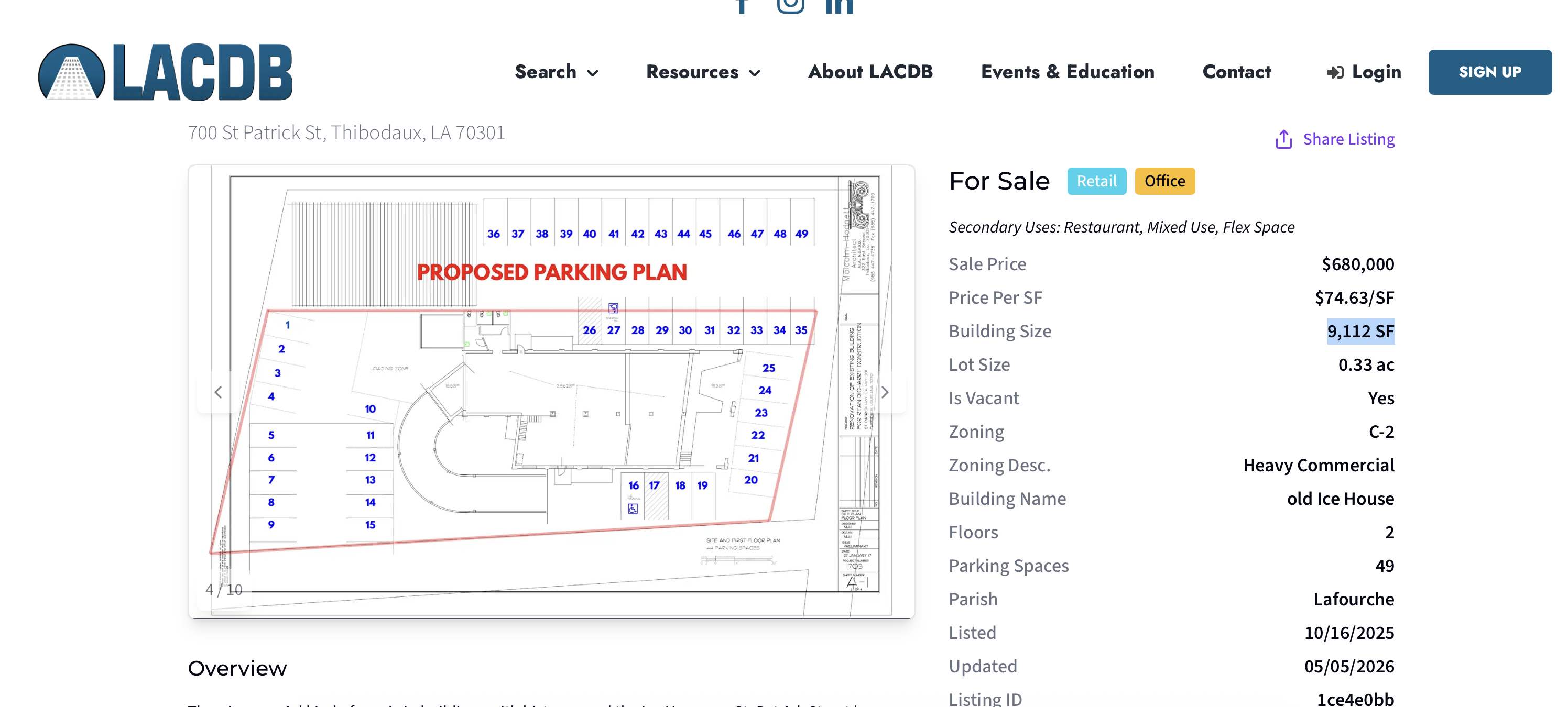
The plan – assuming the purchaser of the property would be willing to build more parking – is to build 49 spaces. That might seem like plenty to you, but for the Ice House to become a bar again, it wouldn’t be enough. The minimum parking ratios say it would need 1 parking space per 100 square feet of gross floor area. It would need 91 spaces (9,112 ÷ 100 = 91.12). Maybe the Ice House really needs all 91 spaces. Maybe it doesn’t. The fact is the city shouldn’t need to determine the appropriate number of parking spaces for every possible use in the first place. Businesses and property owners are generally better positioned than a citywide zoning ratio to determine how much off-street parking a particular use requires.
The way I see it, the government’s role is to manage the impacts on public spaces and city infrastructure, enforcing off-street parking safety and curb parking regulations. In other words, Thibodaux’s role is to regulate the effects of inadequate parking instead of dictating the amount. The private property owner’s role is to make sure they provide enough off-street parking for their business to be successful. There’s no zoning ordinance saying every Thibodaux fast food restaurant must have a drive-through. Yet, all fast food businesses here have one.
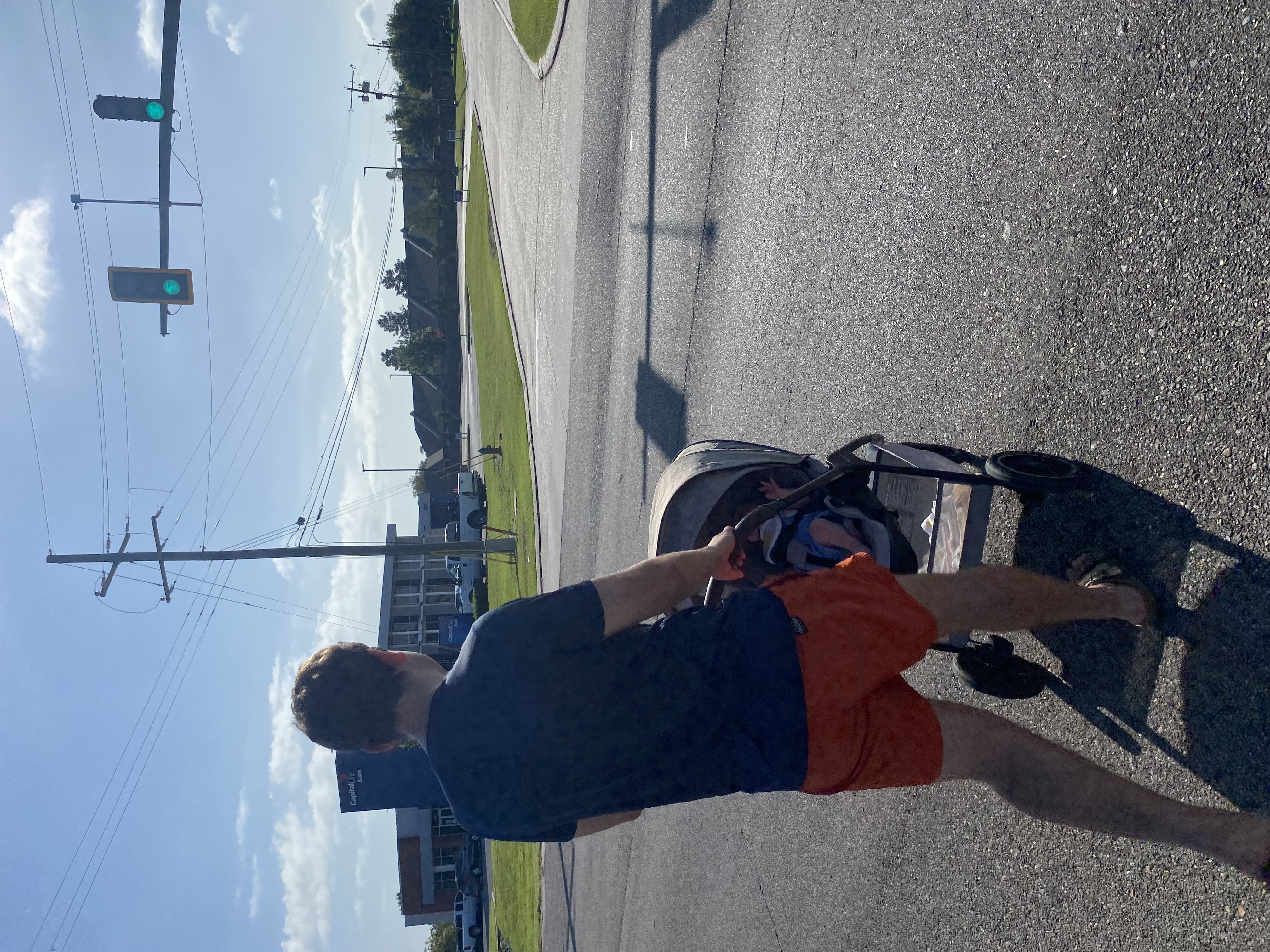 The only "safe" way to cross N Canal Blvd. There's no crosswalk but a sidewalk on one side.
Once I finished reading my last research paper on minimum parking ratios, I knew I had completed my transformation from a man who occasionally wondered about parking lots to a man completely obsessed with parking. I had to do something about it or at least try. All the months of research and learning culminated in my proposed amendment to Article 7 of the City of Thibodaux Comprehensive Zoning Ordinance to reform the City’s minimum off-street parking requirements.
I’ve contacted the Planning and Zoning Commission with my proposal and if I give them the $30 fee, I’ll get a chance to appear before the committee with my case and amendment. Will I be successful? Probably not the first go around, but I truly believe in making Thibodaux a better place and removing parking minimums will do just that. Cities aren’t accidents. They are shaped and molded by policy and laws. They might just seem like arbitrary legal documents, but making sure they promote the city I believe most people wish to live in matters. Below is my full amendment to remove Thibodaux’s minimum parking requirements citywide.