Thoughts on Minimum Parking Requirements: The Hidden Flood Cost
I’ve recently written in depth about minimum parking requirements in zoning codes, where I describe the rationale for removing them entirely in Thibodaux. You can read the entire blog post here.
To summarize briefly: myself and many others such as the late Donald Shoup, a famous UCLA economist and urban planner who published the now famous 1999 paper The Trouble with Minimum Parking Requirements, or Stephen Jean, the new Director of Planning for Shreveport who successfully convinced the city to remove minimum parking requirements citywide in 2025, argue that letting the free market decide how much off-street parking is required reduces the surplus in off-street parking and benefits all parties involved.
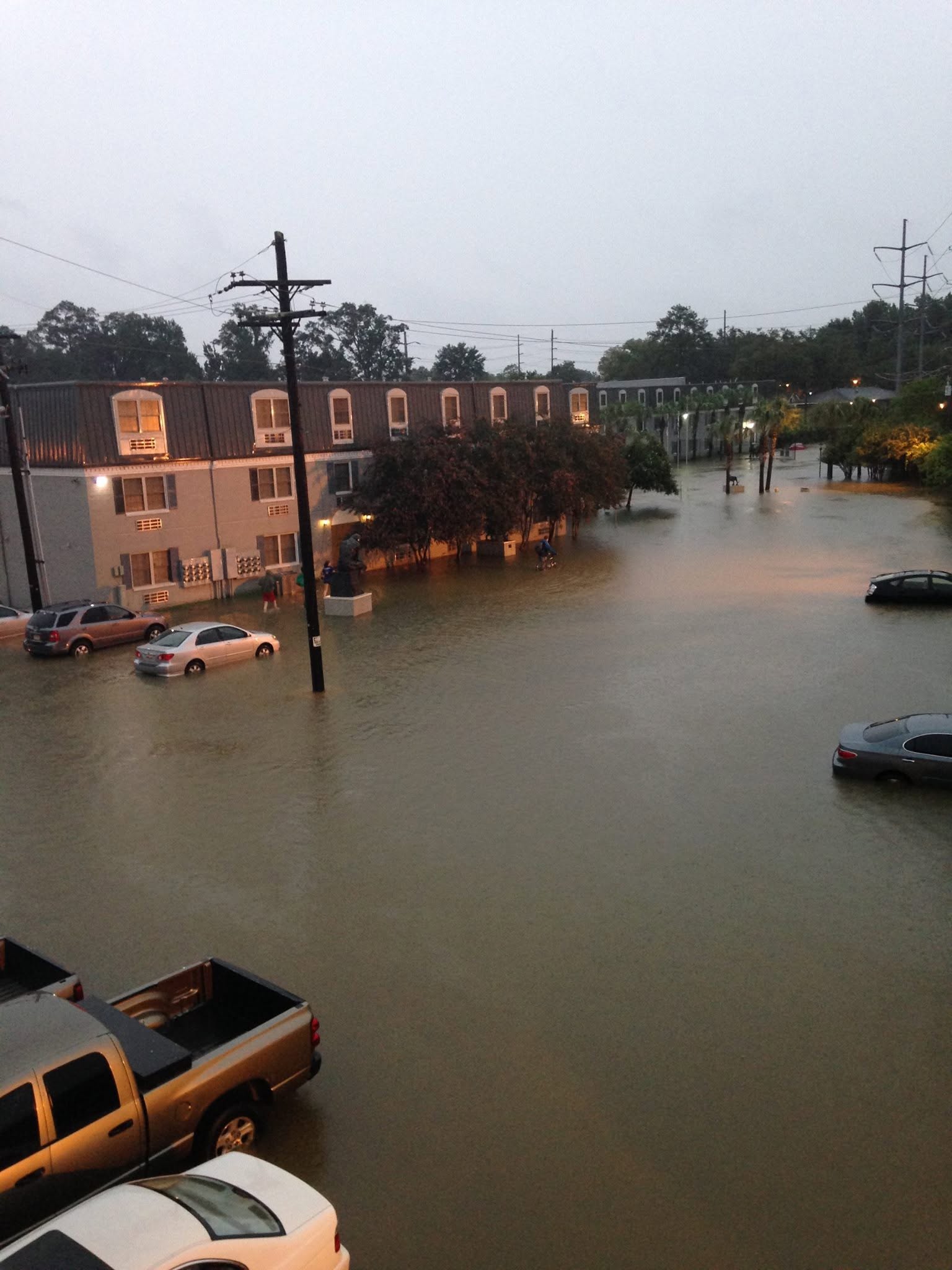 My wife and I's Baton Rouge apartment complex flooded back in 2016
In my fourth bullet, Parking isn’t free, I briefly mention one often overlooked consequence of zoning codes that mandate excessive off-street parking: they increase flash flood risk. I’d like to discuss this point more here given the recent flash flooding events in Thibodaux, its specific importance to south Louisiana where managing flood risk is critical to a city’s success or failure, and the recent news that the City Council approved a $55.8 million budget for improving drainage infrastructure.
I agree investing in the drainage system is necessary. However, an additional inexpensive way the city could reduce this risk is by amending the zoning code and removing minimum off-street parking requirements. It’s well known that surface-level asphalt parking lots increase stormwater runoff and flood risk. A recent study found that a “one percentage point increase in impervious basin cover causes a 3.3% increase in annual flood magnitude.”
Unfortunately, Thibodaux’s zoning laws don’t just require many businesses to build parking that the market may not demand — it also makes it more difficult to share existing parking. For example, the ordinance generally requires shared parking to be located within 300 feet (1 minute walk) of the use it serves. That arbitrary distance can prevent two willing property owners from sharing an existing parking lot simply because it is a little farther away, even when customers or employees would readily make the short walk. Instead of better utilizing surrounding lots, such as the Foundry on the Bayou’s lot bordering downtown, with shared parking agreements, the ordinance can push property owners toward constructing additional parking lots, creating even more impervious surface and placing additional strain on the city’s drainage system.
The city is therefore, in some cases, exacerbating the problem it’s spending millions of dollars to solve by mandating a surplus in off-street parking. By requiring or encouraging more pavement than is actually needed, the zoning code increases the load on the drainage system, contributes to flood risk, and ultimately shifts those costs onto local taxpayers. I’d bet many residents are unaware of these arbitrary and counterproductive zoning regulations — I certainly wasn’t until I began researching them. I’m hoping to change that.