Paved Over: The Space We Waste
Parking is necessary, but requiring more parking than the market actually needs can make cities less fiscally productive.
The most valuable asset a city has is land. Both the residents and government benefit from utilizing that land well. Similar to how a sugar cane farmer tries to maximize their total crop yield and revenue per acre, a city tries to maximize the land’s economic productivity, community vitality, and tax revenue per acre.
Land by itself has value and is taxed, but what’s build on top of that land matters even more. In Louisiana, land is assessed at 10% of its fair market value, while commercial improvements are generally assessed at 15%. Things built on top of the land are called land improvements for tax purposes. Improvements are things like buildings, houses, apartments, and parking lots. The amount actually paid depends on the applicable millage rates and exemptions.
Instead of comparing the total tax base of a city, it’s better to look at the taxes per acre. It wouldn’t make sense to compare one farmer’s crop revenue to another, when one farmer has 120 more acres of land than the other. They use metrics like yield per acre. Similar to farmers, cities should use a similar metric, and that metric is taxes per acre. A city with more taxable value per acre has a larger potential revenue base from the same amount of land, giving it greater fiscal capacity to provide roads, drainage, parks, public safety, and other services. The interesting things is that one city could theoretically have higher property taxes per acre than another even when it has a lower effective tax rate by making it more advantageous for people to better utilize the land. The thing is: each asset built on the land contributes differently to the city’s tax base, irrespective of how high or low the tax rate is. Everyone benefits when land is used to its highest economic benefit.
One of the least fiscally productive common uses of urban land is a large asphalt parking lot. Every city needs parking, but having an oversupply of parking can hurt a city in a real way. This isn’t a new idea, either. Urban3 and Strong Towns have used tax value per acre to demonstrate how different development patterns affect municipal finances, while the late parking researcher Donald Shoup has documented the substantial property-tax opportunity cost of land devoted to parking. A parcel that has a large portion of its land devoted to a parking lot has a high opportunity cost. Let’s see why.
Lafourche Parish Assessor’s Office assesses parcels every 4 years. When assessing a property’s improvement value, depreciation of the asset (the asset’s lifespan) is also taken into account. Using illustrative depreciation assumptions of 15–20 years for a parking lot and roughly 40 years for a building, the difference becomes significant over time. Let’s assume there’s two parcels in Thibodaux. Parcel A (the blue line) is a law office building downtown, which has no parking lot, since it’s downtown and its parking demand is satisfied by legal curb parking. Parcel B is a parking lot.
At year 0, both are valued by the Assessor’s Office and 100% of their assessed value can be taxed. A standalone parking lot does not itself generate sales-tax revenue, and its taxable value is generally lower than that of a building used for office, retail, residential, or other productive purposes. Even though the newly built parking lot does generate more revenue than if nothing was there at all, the opportunity cost of parcel B being a large parking lot instead of a more productive asset increases over time because of the steeper depreciation curve. The chart below depicts how the opportunity cost grows over time.
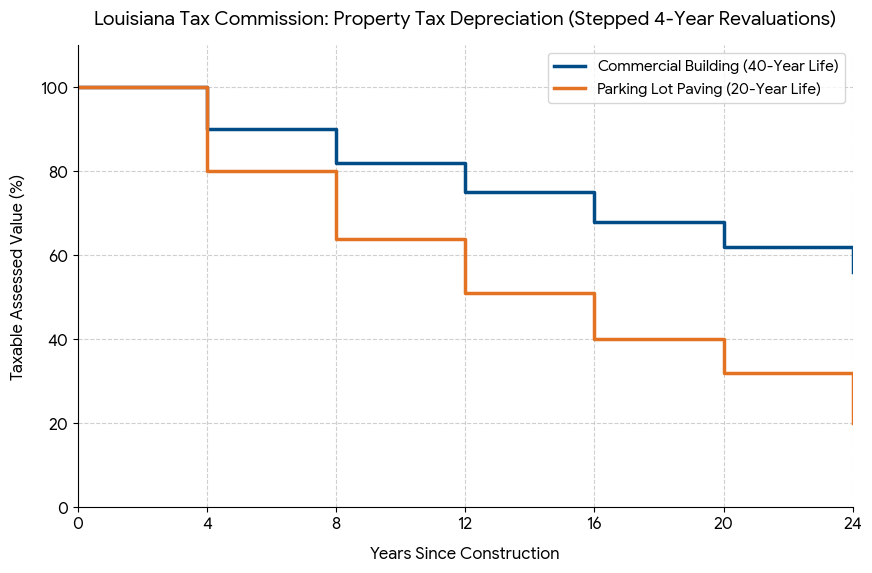
Under these illustrative assumptions, 24 years after construction, roughly 35% of the parking lot’s initial value remains, while the building retains roughly 60%. This doesn’t even account for the loss sales tax revenue because parcel B is entirely a parking lot. And even when a parking lot adds some property-tax revenue, that revenue has to be weighed against the infrastructure, drainage, road, and maintenance costs associated with serving a highly paved, low-intensity use. Below are some examples in Thibodaux showing how parking lots have a higher opportunity cost relative to other land uses.
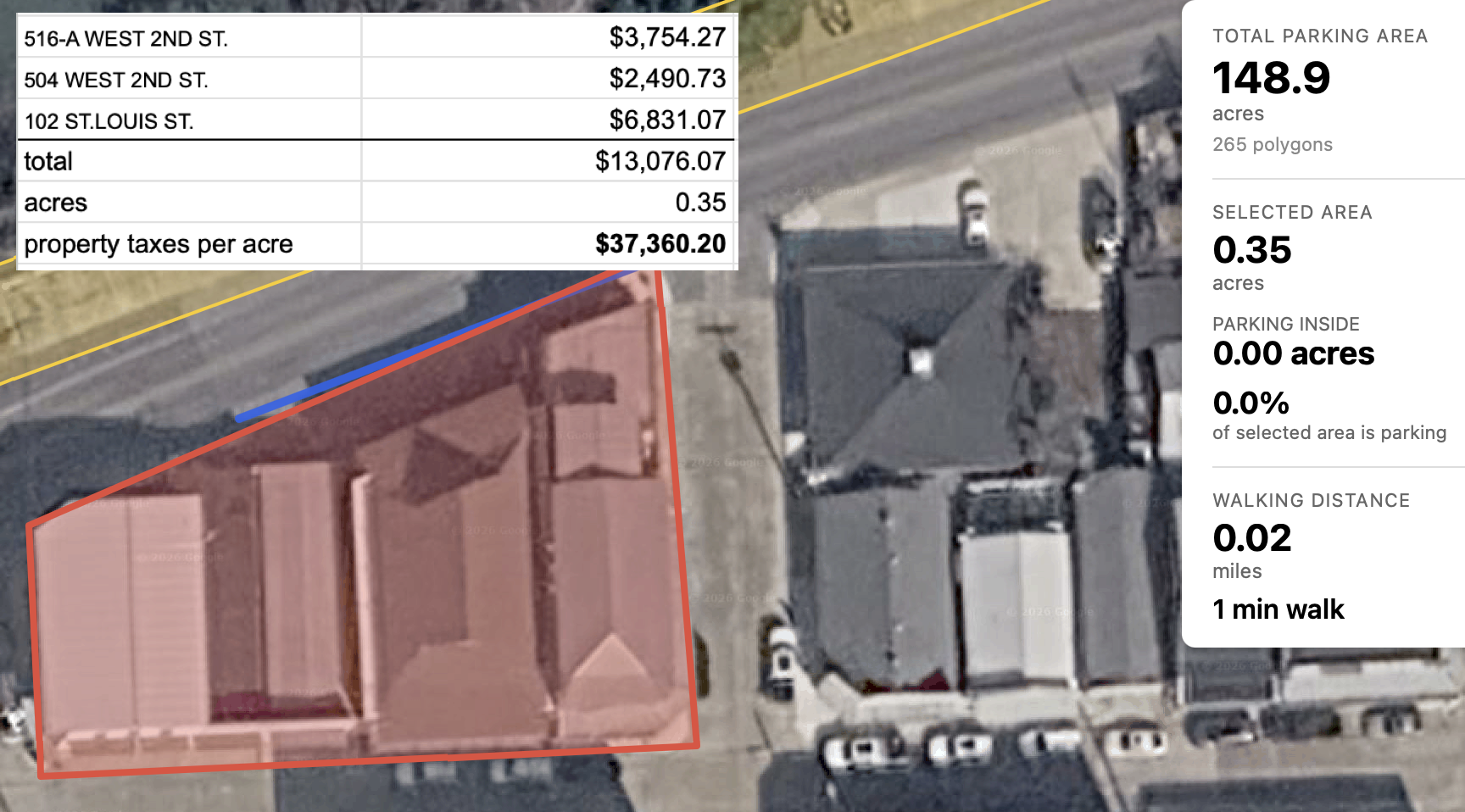
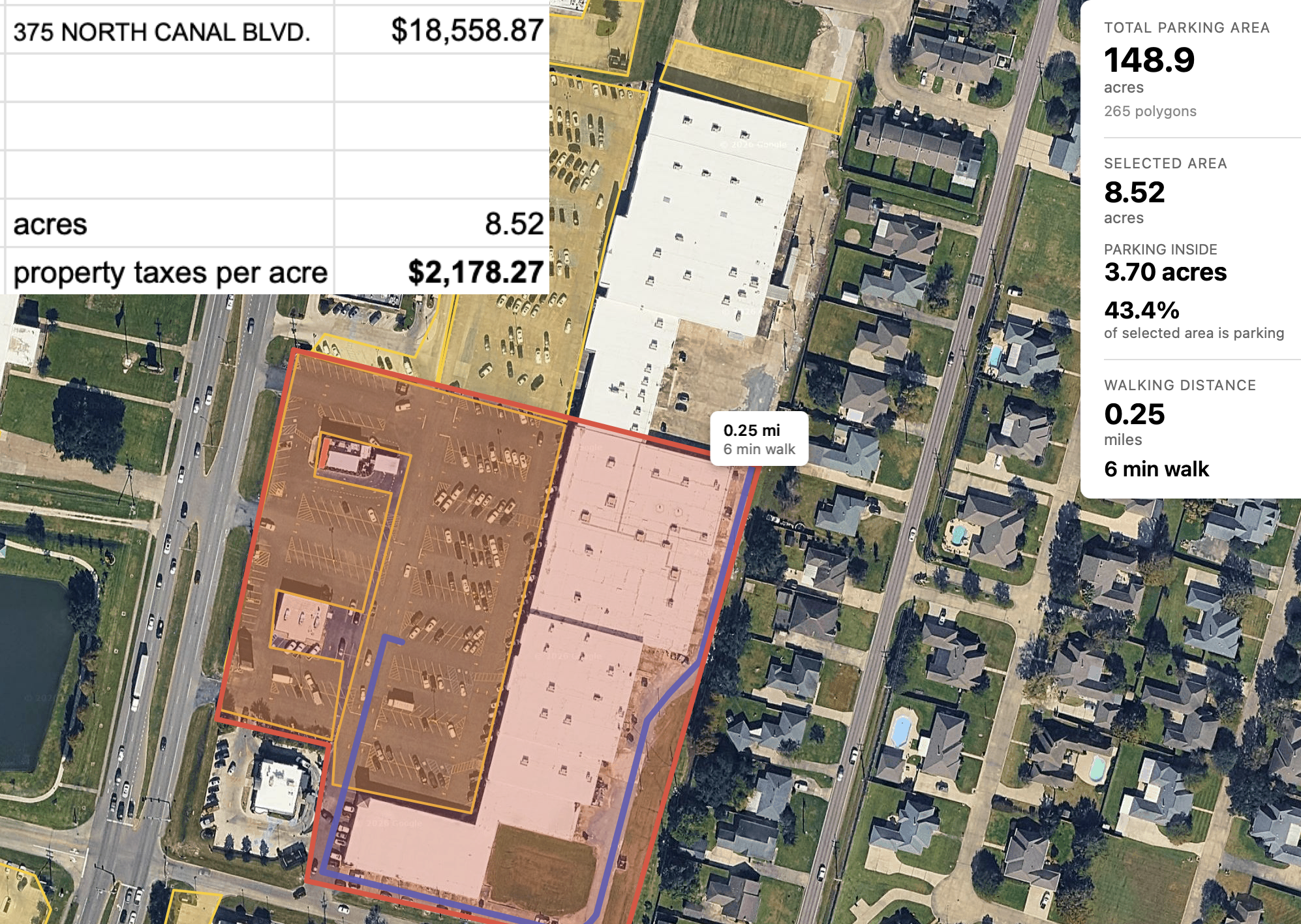
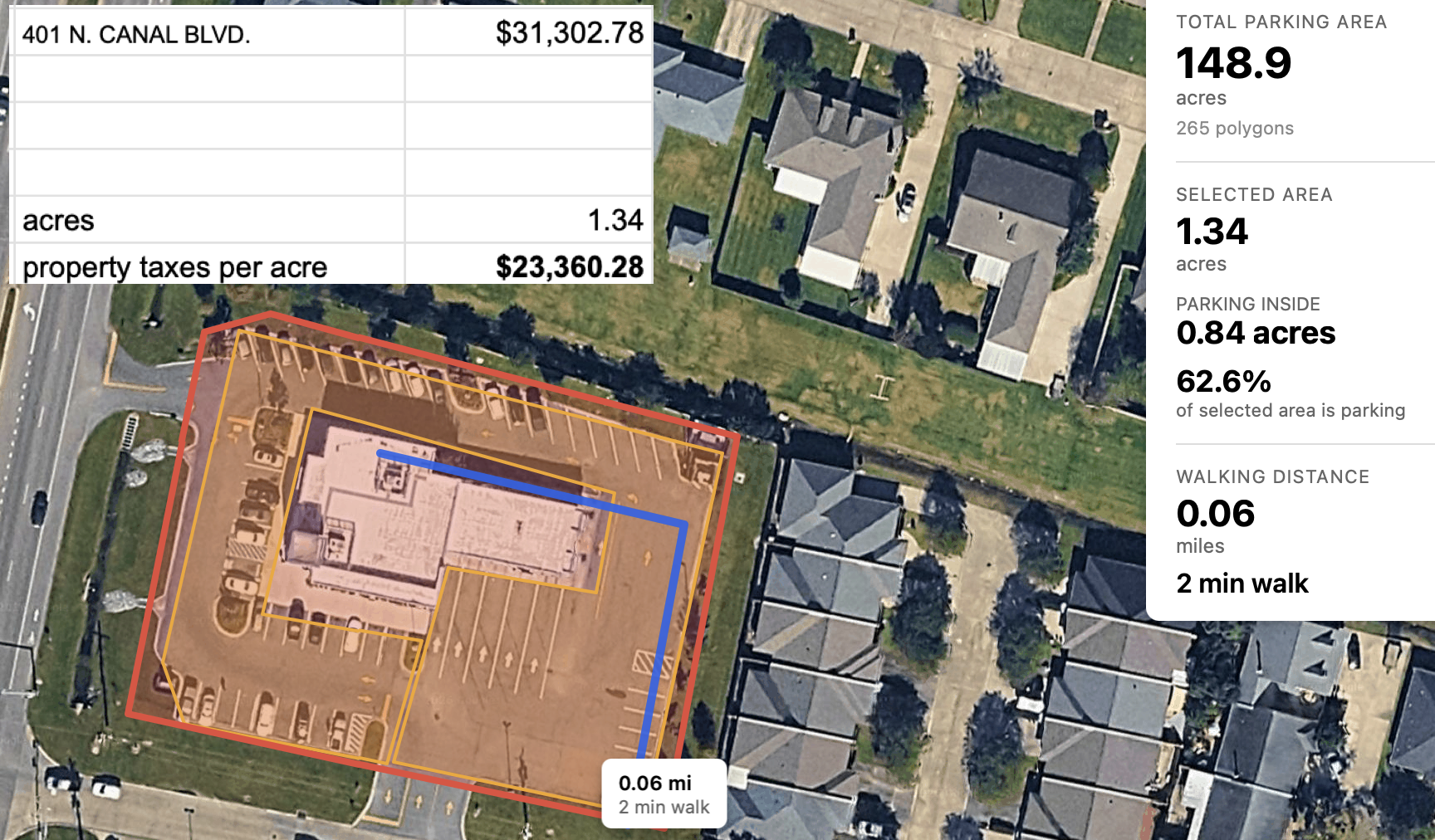
Even the newly built Capital One, at $23,360 per acre, has a lower property-tax yield per acre than all three of the downtown local businesses, which yield $37,360 per acre. The Rienzi Plaza parcel has the lowest at $2,178 per acre, and the parking lot takes up 43% of the parcel.
The strange thing is that places like Thibodaux mandate, via zoning ordinances, that every singe parcel contain its own dedicated parking lot, where the amount is almost always determined by the square footage alone of the building and the land use. In practice, these laws create an oversupply of off-street parking. I’ve created an app that calculated almost all the off-street parking lots in Thibodaux, LA. The total acres of parking lots in Thibodaux is roughly 150 acres.
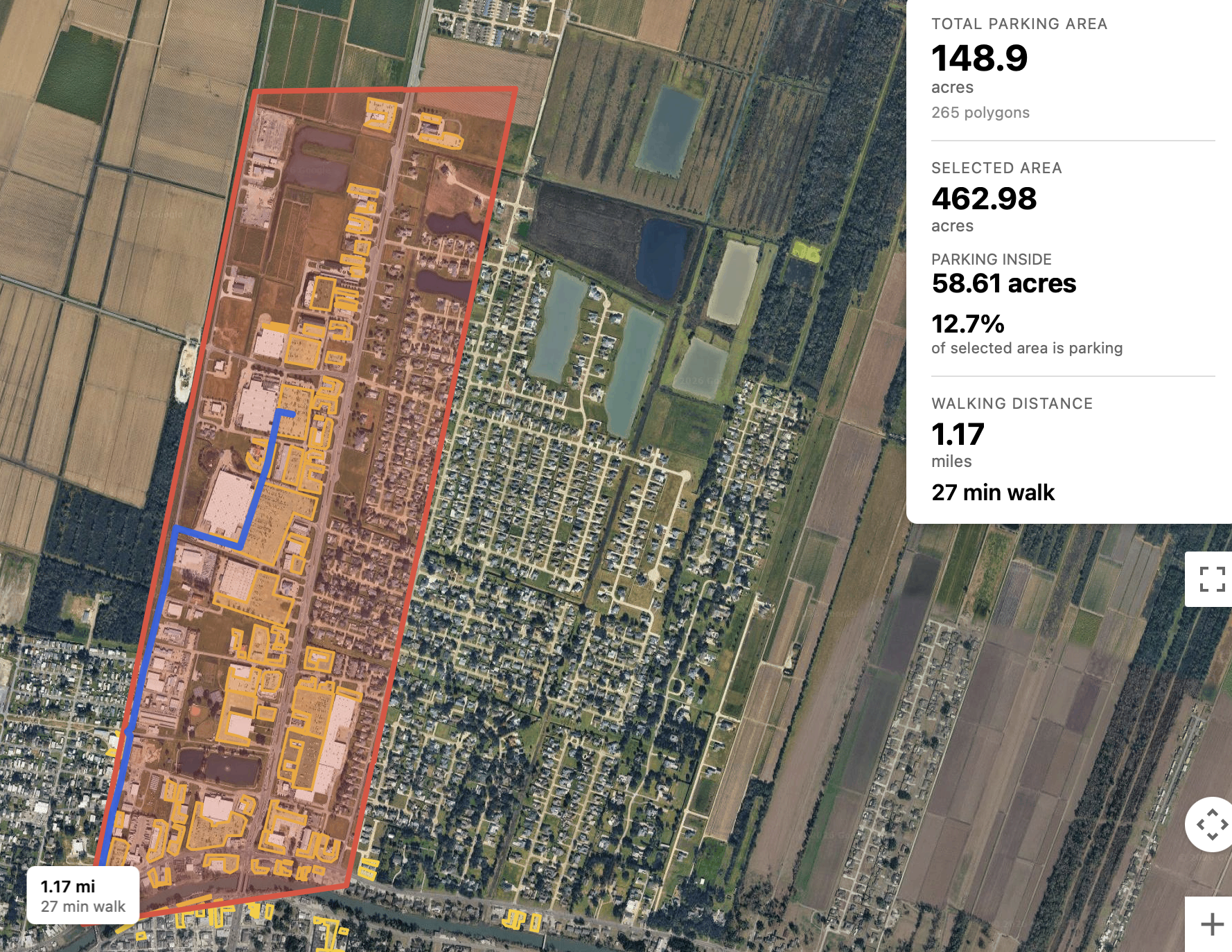
Thibodaux also has laws for Shared Parking Agreements, legal contracts that lets two or more property owners safely split and use the same parking area. Some of these laws prevent existing parking from being better utilized and likely prevent wider adoption. For example, for a shared lot to count toward a business’s legal parking minimum, the code dictates a strict radius of 300 feet of the building’s main entrance. This makes your 10-minute walk (~2,640 feet) legally useless for fulfilling mandates, forcing developers to build new pavement right next to their front doors even if a sidewalk connects both businesses.
Parking is necessary, but requiring more parking than the market actually needs can make cities less fiscally productive. This is just one of my many reasons for wanting to work with the City of Thibodaux to eliminate off-street parking requirements citywide and allow businesses and property owners to make better use of the parking that already exists. The Central Business District (a small area in downtown) is already exempt from these requirements, demonstrating that Thibodaux doesn’t need a one-size-fits-all parking mandate.
I believe parking should be treated like any other market good: provide enough to meet demand, but don’t force property owners to build more of it than they need. If we want Thibodaux’s limited land to generate more housing, businesses, activity, and tax revenue, we should stop requiring so much of it to be covered in asphalt.